
ACTUAL PRODUCT / RECORDED INTERNAL TESTS
See AutoSolve do the work.
Inspect an AI-generated Linux cleanup that was approved, executed and verified. Watch a separate request move through investigation and generation, and explore the Windows endpoint result.
The fix is only part of the work.
A Linux test server needed temporary space reclaimed without restarting a service. AutoSolve's record contains an AI-generated cleanup, human approval, execution output and a passed verification check.
- The request
- Reclaim stale temporary files. Preserve active files. Do not restart services.
- AutoSolve's work
- Generate the cleanup, execute the approved action and retain the outcome checks.
- The recorded change
- Temporary-file usage: 40,964 KB before; 4 KB after.
July 17, 2026 internal test, shown in the current interface. Human approval was recorded. Original investigation and plan screens were not preserved. This is action-level evidence, not customer performance or proof of an unattended incident recovery.
Show me the work my team could hand overTemporary-file usage · Recorded internal test
Inspect the approval and verification record
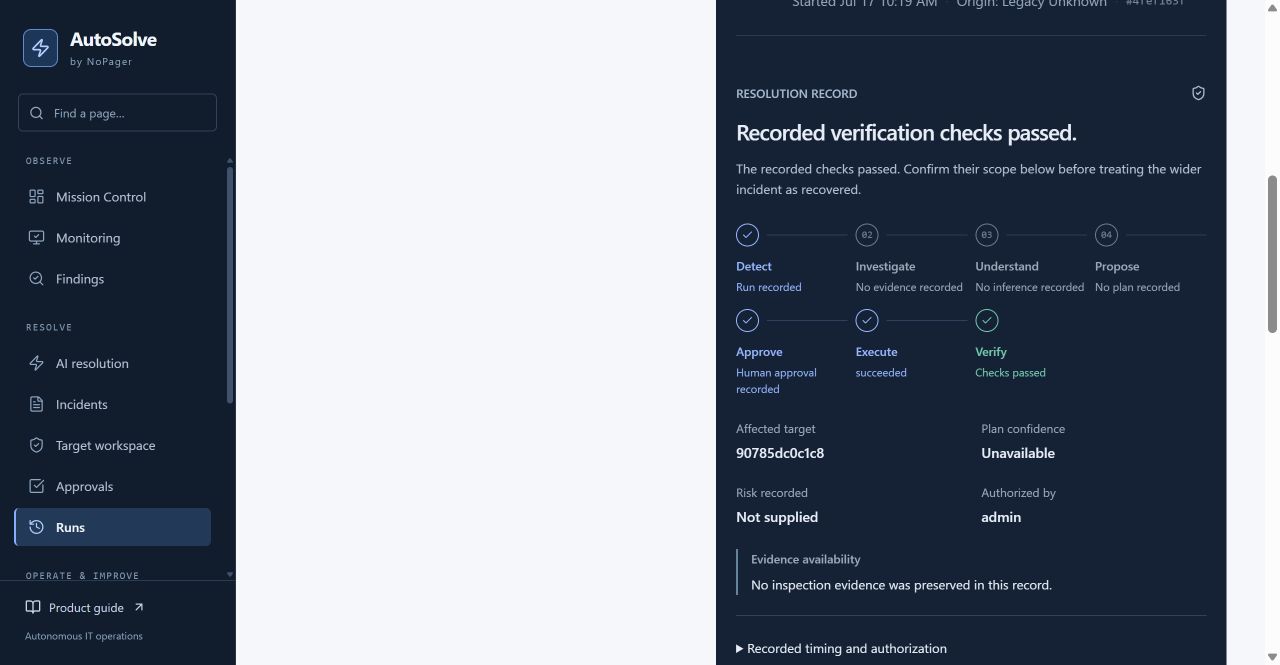
Approval, execution and verification are separately recorded. Earlier investigation evidence is unavailable in this historical record.
AutoSolve did more than suggest a command.
In this Windows test, AutoSolve flushed the DNS resolver cache. Its stored output shows the action completed and its verification check passed.
- The action
- Clear the device’s DNS resolver cache.
- AutoSolve’s output
- “Successfully flushed the DNS Resolver Cache.”
- The evidence
- Execution output and a passed verification check, retained in the run record.
July 28 internal test, displayed in the current interface. This proves the recorded action and check, not recovery of every website or the wider incident.
Show me relevant endpoint workA request becomes a new diagnostic.
We asked AutoSolve to inspect a Linux server’s disk usage and prepare a reusable, read-only diagnostic. It collected system evidence and generated the solution.
- AutoSolve inspects the connected system.
- AI creates a diagnostic from the request and evidence.
- Static validation passes.
- The policy holds execution for review.
October 7 internal test · 30-second edited recording. This diagnostic was not executed. It is separate from both completed actions shown here.
Explore AI solution generationRead the recording transcript
Request: inspect Linux disk usage, identify large folders and prepare a reusable read-only diagnostic. AutoSolve collects resource and log evidence, generates the solution, and reports passed static validation. The configured policy requires approval before execution; this test stops at that point.
Describe the procedure.
AutoSolve builds the proposed work.
The October 7 request asked for a diagnostic that could be reused, not just advice for one ticket. This capture shows the generated analysis, static validation and review requirement.
Beyond this recorded preparation, AutoSolve’s automation system supports configured schedules, events, webhooks and manual triggers.
Same October 7 Linux test as the investigation tab. This capture does not demonstrate a scheduled execution. Ask to evaluate a recurring workflow relevant to your business.
Show me a recurring workflowPUT THE EVIDENCE IN CONTEXT
Different tests.
Clearly stated outcomes.
The July 17 Linux cleanup and July 28 Windows action have recorded execution and verification results. The October 7 recording demonstrates investigation, generation, static validation and a review hold. These are separate internal tests, not one continuous workflow or customer performance data.
Review the broader evidenceNow test the work that matters to you.
Bring an employee support issue, recurring incident or manual procedure. We'll demonstrate the relevant path and identify the systems, access, approvals and outcome checks needed for a scoped pilot.
Show me my team's workflow